

How Can Parents Tell Whether Their Teen Has Maths Anxiety?
If the concept of mathematics anxiety is new to you, we recommend starting with our blog series, When Maths Triggers Anxiety, where we explain what maths anxiety is and how it shows up. You can read the first post in the series here.
Parents often have a strong intuition when something isn’t quite right with their teenager’s learning experience. You may notice frustration around homework, emotional shutdowns before tests, or a sudden declaration of “I’m just bad at maths.” Still, it can be difficult to distinguish ordinary academic stress from something deeper and more persistent. Identifying maths anxiety is rarely about spotting one dramatic sign; rather, it involves noticing patterns over time, listening carefully, and understanding how emotions, beliefs, and behaviours interact.
Below are evidence-informed, parent-friendly ways to explore whether maths anxiety may be part of your teen’s experience, without turning the process into an interrogation or diagnosis.
Pay attention to emotional reactions, not just results
Grades alone are not a reliable indicator. Many teens with maths anxiety perform adequately, especially if they rely on memorisation or last-minute cramming. What often stands out instead is the emotional response that surrounds maths-related activities.
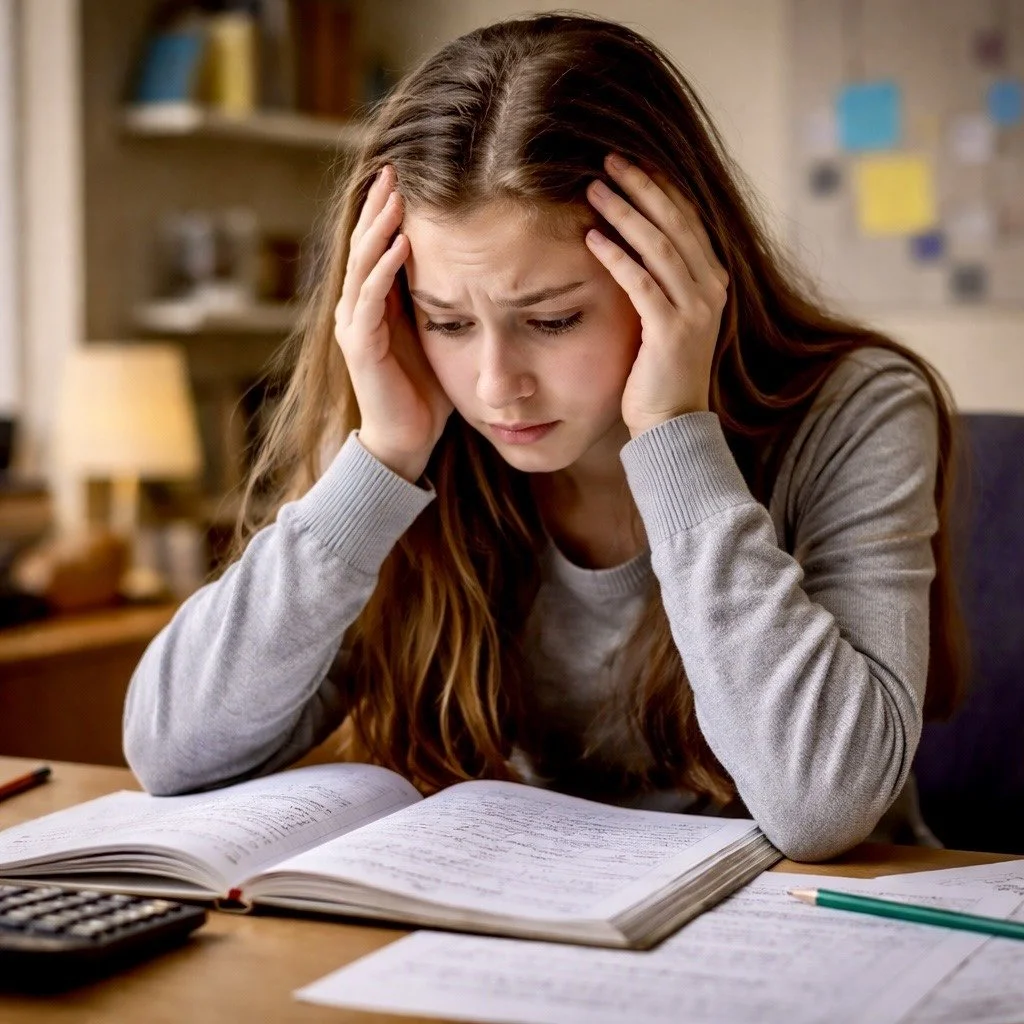
Notice whether your teen:
Becomes unusually tense, irritable, or withdrawn when maths homework is mentioned
Shows visible stress before maths tests (headaches, stomach aches, trouble sleeping)
Overreacts emotionally to small mistakes in maths but not in other subjects
A key clue is disproportionate emotional intensity. If a single incorrect answer triggers tears, anger, or complete disengagement, anxiety may be driving the response rather than lack of understanding.
Listen closely to the language they use about maths
Teens often reveal their internal beliefs through casual comments. Phrases such as:
“My brain just doesn’t work that way”
“I panic and forget everything”
“I know this at home, but my mind goes blank in class”
“There’s no point trying. I’ll fail anyway”
These statements are not just expressions of frustration; they can reflect deeply held beliefs about ability, intelligence, and threat. Maths anxiety frequently involves a fear-based narrative about maths as something dangerous, humiliating, or exposing.
Observe avoidance and procrastination patterns
Avoidance is one of the most reliable behavioural markers of anxiety. A teen who consistently delays maths homework, “forgets” assignments, or insists on doing everything except maths first may not be lazy or unmotivated.
Look for:
Chronic procrastination specifically tied to maths
Requests for excessive help, followed by disengagement
Rushing through maths work carelessly just to “get it over with”
Choosing subjects, electives, or career ideas that minimise maths exposure very early on
Avoidance often coexists with high effort. Many anxious students spend more time worrying about maths than actually doing it.
Notice differences between home and school performance
A classic sign of maths anxiety is a sharp contrast between what a teen can do in low-pressure settings and what they demonstrate under observation or time constraints.
You might notice that your teen:
Solves problems accurately at home but freezes in tests
Understands concepts when explained one-on-one but struggles in class
Performs worse when watched, timed, or called on unexpectedly
This discrepancy can point toward anxiety interfering with working memory and concentration, rather than gaps in knowledge.
Reflect on your teen’s maths history
Maths anxiety rarely appears out of nowhere. It often builds gradually after specific experiences, such as:
A humiliating classroom moment
A sudden increase in difficulty without adequate support
A teacher-student mismatch in style or expectations
Repeated emphasis on speed, competition, or public performance
Gently exploring past experiences can be illuminating. You might ask:
“When do you remember maths starting to feel stressful for you?”
Listen for emotional turning points rather than factual details.
I’ve written a detailed explanation of how mathematics anxiety begins in this blog post.
Consider physical and cognitive signs during maths tasks
Anxiety is both emotional and physiological. During maths-related activities, some teens experience:
Racing heart, shallow breathing, or sweating
Mental “blankness” or inability to recall steps they know
Difficulty concentrating or following multi-step problems
If these symptoms appear mainly during maths and not across subjects, anxiety may be a key factor.
Use simple, non-threatening check-ins
You don’t need formal questionnaires to open the conversation. Short, low-pressure questions asked at neutral moments can yield valuable insight:
“How do you usually feel right before maths class?”
“What’s the hardest part about maths for you — not the content, but the experience?”
“If maths were taught differently, what would you change?”
The aim is to create psychological safety. Teens are more likely to disclose anxiety when they feel believed and not judged.
Trust patterns more than single incidents
Every student has bad days, difficult topics, and disappointing grades. Maths anxiety reveals itself through consistency: recurring fear, avoidance, negative self-talk, and emotional distress tied specifically to maths.
If several of the signs above cluster together over weeks or months, it may be worth exploring supportive strategies or professional guidance.
A final thought
Discovering that your teen may be struggling with maths anxiety is not a verdict; it is information. Awareness is the first step toward reducing unnecessary suffering and helping your child reconnect with learning in a calmer, more confident way. By observing gently, listening carefully, and staying emotionally available, parents play a powerful role in noticing what grades alone can never show.
In the next step, the question becomes not “What’s wrong with my child?” but rather “What does my child need in order to feel safe thinking about maths?”
